What is that bright star?
A very bright “star” tonight that twinkles or moves? Here is how to recognise it in seconds, with or without a phone.
🔭 Identify the star nowvigi-sky.com/sky · free · no install · nothing is uploadedThe brightest “star” you see in the evening is very often a planet: Venus (low in the west after sunset, or in the east before dawn) or Jupiter. The brightest true star is Sirius, in winter. If it moves without blinking, it is a satellite, often the ISS. To be sure, point your phone at it: Vigi-Sky tells you its name.
Tonight in your sky
The planets visible tonight and when, computed in your browser for the chosen city (or your location: it never leaves your phone).
How it works
- Open vigi-sky.com/sky on your phone, outdoors, facing the sky.
- Allow the three permissions: orientation (where you aim), camera (the viewfinder, nothing is recorded or uploaded) and location (the sky depends on where you are).
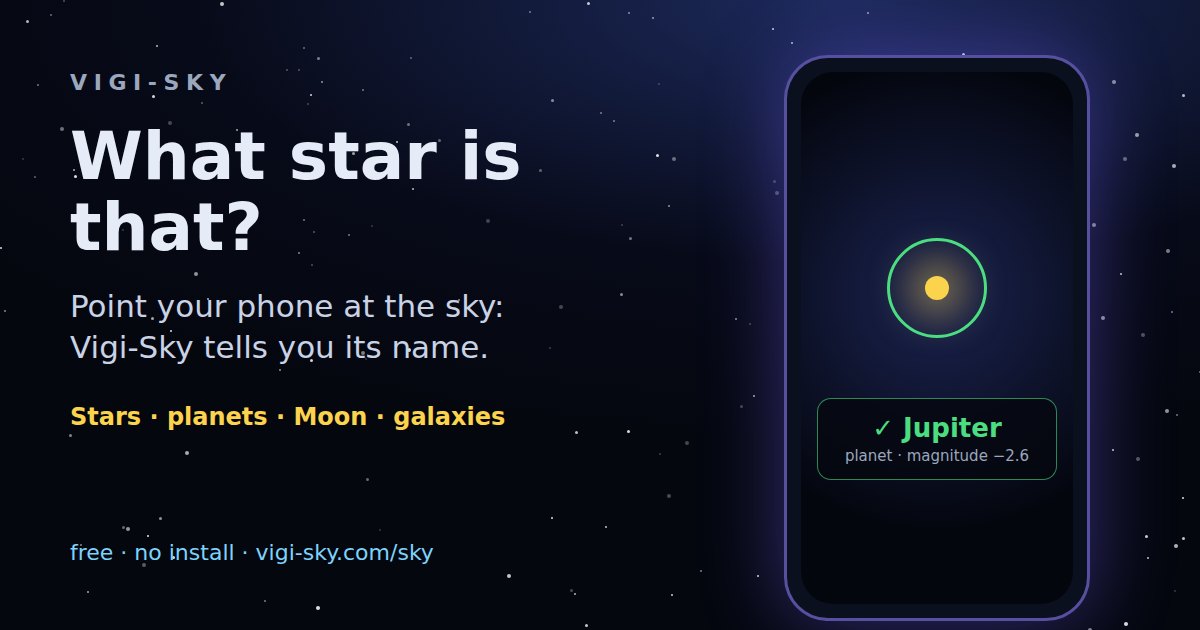
- Aim at the object: once it is inside the circle, the reticle locks and shows its name, constellation and magnitude.
- Tap “Share my find”: your phone creates an image card showing where the light you see comes from (“Its light left in 2001”). No GPS position on it.
- The shared link is a challenge: friends open it and an arrow guides them to the same object in their own sky.
The catalogue holds 330 named stars (official International Astronomical Union list), 5,000 field stars, 110 Messier objects (nebulae, clusters, galaxies), the planets, the Moon and the Sun. Binocular mode adds 36,000 stars.
The brightest objects in the night sky
| Object | Brightness (magnitude) | When and where | How to recognise it |
|---|---|---|---|
| Venus (planet) | up to −4.7 | Low in the west in the evening, or in the east at dawn; never in the middle of the night | White, dazzling, barely twinkles |
| ISS (space station) | up to about −4 | Passes of a few minutes, mostly after dusk or before dawn | Crosses the sky without blinking; see upcoming passes |
| Jupiter (planet) | up to −2.9 | Much of the year, sometimes all night | Creamy white, steady light |
| Mars (planet) | from +1.8 to −2.9 | Depends on its distance from Earth | Clearly orange |
| Sirius (star) | −1.46 | Winter evenings, low in the south-east then south | Twinkles strongly, with flashes of colour when low |
| Arcturus (star) | −0.05 | Spring and summer | Orange, following the arc of the Big Dipper's handle |
| Vega (star) | +0.03 | Summer, high overhead | Blue-white, top of the Summer Triangle |
| Capella (star) | +0.08 | Autumn and winter evenings, in the north-east | Yellow, twinkles a lot when low |
| Saturn (planet) | from +1.3 to −0.5 | Depends on the year | Pale yellow, steady light |
The smaller (or more negative) the magnitude, the brighter the object. Canopus, the second-brightest star, never rises from Europe or the northern United States: it is only visible south of about 37° N.
Star or planet?
A star is so far away that it appears as a point, so the atmosphere makes it twinkle. A planet shows a tiny disc, so its light is steadier. Another clue: planets always stay close to one line across the sky, the ecliptic, the path of the Sun and Moon.
If the object is very bright, does not twinkle and sits low in the west just after sunset, it is almost always Venus.
Why it flashes different colours
Near the horizon, starlight crosses a thick layer of turbulent air that bends it and splits it like a prism. A bright, low star such as Sirius in winter or Capella in autumn then seems to flash red, green and blue. It is one of the most common mix-ups in “UFO” reports.
What if it moves?
- It glides slowly and steadily without blinking: a satellite. The brightest are the ISS and Starlink satellites, sometimes in a line just after launch.
- It blinks red, green or white: an aircraft.
- It seems to drift when you stare at it: the autokinetic illusion, an effect of the eye. Lean against a wall or a post to check.
If the object moves and remains unexplained, use the Witness station: it measures the track and checks known satellites. In France, official reports go to GEIPAN (CNES); elsewhere, contact your national reporting body.
Frequently asked questions
What is that very bright star tonight?
Most often it is not a star but a planet: Venus (low in the west after sunset, or in the east before dawn) or Jupiter. To know for sure, open vigi-sky.com/sky on your phone and aim at it: the tool shows its name within seconds.
What is the brightest star in the sky?
After the Sun, it is Sirius, at magnitude −1.46, visible on winter evenings in the south-east then south. Venus and Jupiter are often brighter, but they are planets.
Why does this star flash different colours?
Near the horizon, turbulent air bends and splits starlight. A bright, low star such as Sirius or Capella then seems to flash red, green and blue. It is a normal atmospheric effect.
How can I tell a star from a planet?
A star twinkles; a planet shines with a steadier light. Planets also stay near the ecliptic, the path of the Sun and Moon across the sky. Vigi-Sky Sky computes the planets' positions for your location and tells you directly which one you are aiming at.
The star is moving: is it a satellite or a UFO?
A point gliding steadily without blinking is almost always a satellite, often the ISS or a Starlink satellite. Blinking red and green lights mean an aircraft. If the object remains unexplained, the Vigi-Sky Witness station helps measure its track.
Is there a free app to identify stars?
Yes. Vigi-Sky Sky runs directly in your phone's browser, with no install and no account. It uses the phone's compass, tilt and location; the camera is only a viewfinder and nothing is uploaded.
Why does the displayed name seem off?
A phone compass can drift by a few degrees, especially near metal objects. Sweep slowly around the object: the right name is the one that stays closest to the centre. For better accuracy, you can calibrate the compass on a satellite from the Witness station.