AI is revolutionizing our understanding of the Universe
How artificial intelligence is transforming astronomy, from exoplanet detection to cosmic signal analysis.
Vigi-Sky is an astronomy and UFO/UAP observation platform combining rigorous science, Claude AI (Anthropic), and the Hatch UDB database of 18,116 historical cases worldwide. Bilingual site (vigi-sky.fr and vigi-sky.com), 100% free, open-source, supported via Ko-fi.
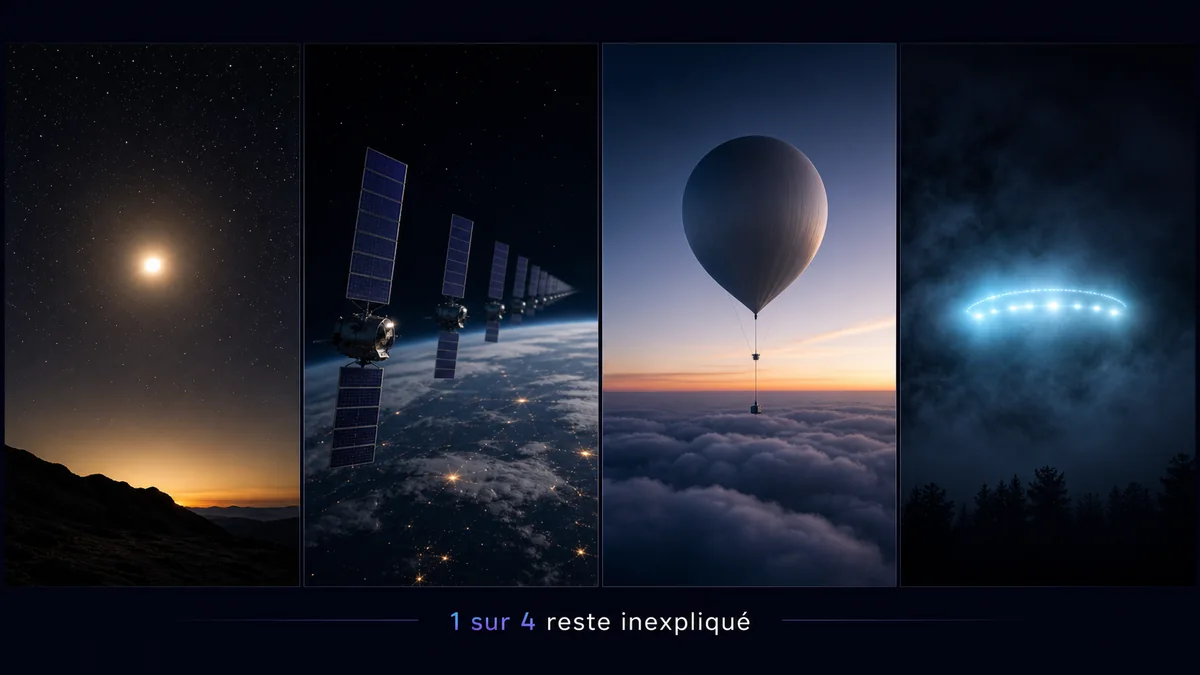
Editorial approach: scientific, open, and honest. Neither automatic dismissal ('weather balloon'), nor credulity. Every observation is cross-referenced with the historical database and analyzed by AI.
Sky Sentinel
Explore the cosmos, report unexplained phenomena, and let artificial intelligence analyze your observations.
Tonight's probability of an unexplained phenomenon, computed in real time from geomagnetic activity, satellite passes, moon phase and weather conditions. Claude AI analysis cross-referenced with 18,116 Hatch UDB cases.
Explore the planets of our solar system
Click a planet
Track the Moon cycle in real time
Illumination: 68%
Astronomical events visible tonight
Let your eyes adapt to darkness for 20 minutes before observing. Avoid screens. Use a red lamp if needed.
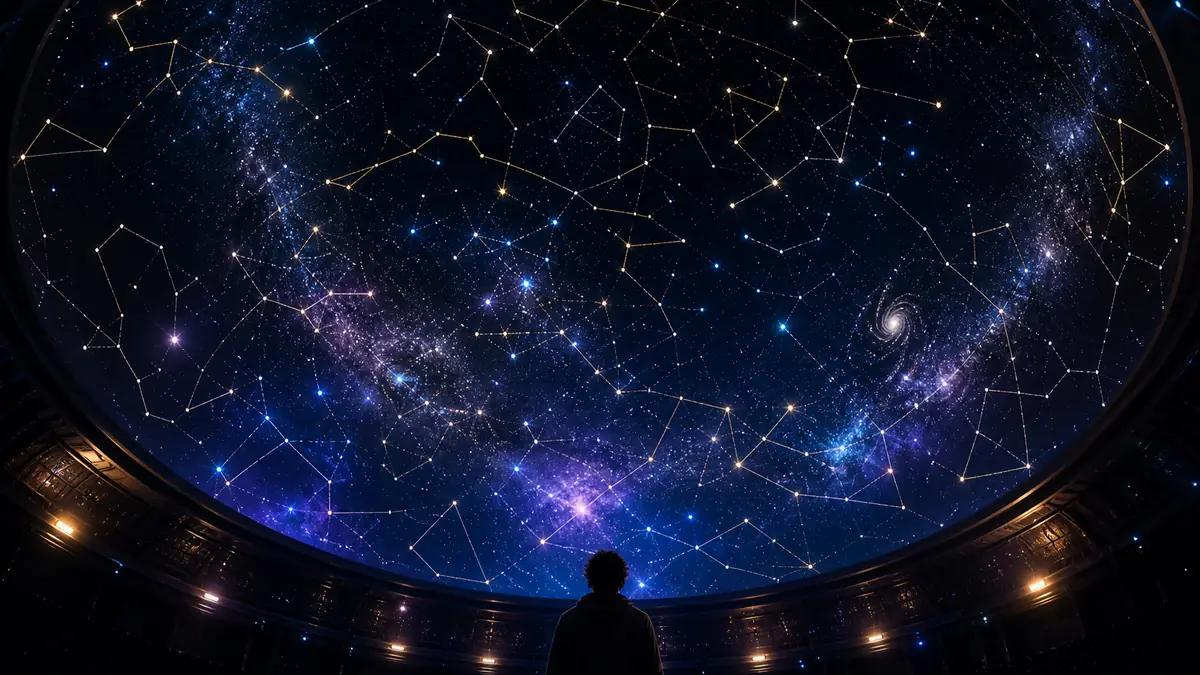
Explore constellations and their myths
Dubhe (alpha)
In Greek mythology, Callisto was turned into a bear by Hera, jealous of her affair with Zeus. Zeus then placed her among the stars to protect her.
Visible year-round (northern hemisphere)
AI-analyzed picture of the day + near-Earth asteroids in real time
NASA's daily astronomy picture with Claude AI contextual analysis: object, distance, instrument, scientific significance.
NASA JPL data loading
NASA JPL NEO API
Earth from space, live Mars, solar flares — real-time NASA data
DSCOVR/EPIC — 1.5 million km
Photos taken by the EPIC camera aboard the DSCOVR satellite, located at Lagrange point L1. Click to enlarge.
Millions of space images — James Webb, Hubble, Juno, Cassini, Apollo
Coronal mass ejections in real time — NASA DONKI
No Earth-directed coronal mass ejection detected
Get an email alert when a coronal mass ejection heads toward Earth, when a rare astronomical event approaches, or when an intriguing observation is reported near you.
Data: NASA DONKI (Space Weather)
Estimate your chances of seeing an aurora tonight, based on solar activity
All the astronomical events not to miss in 2026
January 18, 2026
Venus and Saturn graze each other in the evening sky, separated by only 2°. A brilliant duo at dusk, observable with the naked eye.
February 28, 2026
Total lunar eclipse visible from Europe, Africa and the Americas. The Moon will take on a spectacular coppery hue for over an hour.
March 29, 2026
The two brightest planets come within 1° of each other in the evening sky. Stunning spectacle to the naked eye.
April 10, 2026
Mercury reaches its greatest angular distance from the Sun, making it easier to observe at twilight. Limited observation window.
April 22, 2026
Meteor shower from comet C/1861 G1 Thatcher. Up to 20 meteors per hour at zenith, with occasional very bright fireballs.
May 6, 2026
Debris from Halley's Comet. Up to 50 meteors/h, fast (66 km/s) with long persistent trains. Best from the southern hemisphere.
May 31, 2026
Mars passes close to the star Pollux in Gemini, creating a beautiful red-orange duo visible in the evening.
June 21, 2026
The longest day of the year in the northern hemisphere. Shortest night — enjoy dark skies from late June onward for observation.
July 30, 2026
Moderate summer shower with about 20 meteors/h. Active for several weeks, it often overlaps with the early Perseids.
August 12, 2026
Total solar eclipse crossing the Arctic, Greenland, Iceland and Spain. A rare event with totality reaching 2 min 18 s.
August 12, 2026
The queen of meteor showers! Up to 100 meteors/h from comet Swift-Tuttle. Warm summer nights ideal for observation. In 2026, the peak coincides with the solar eclipse — an exceptional astronomical evening.
August 28, 2026
Partial lunar eclipse visible from eastern Asia, Australia and the Pacific. About 40% of the lunar disk will be in shadow.
September 21, 2026
Saturn is opposite the Sun: closest to Earth, brightest and visible all night. Its rings will be seen nearly edge-on in 2026, a rare phenomenon.
October 8, 2026
Variable shower from comet 21P/Giacobini-Zinner. Usually modest (~10/h) but capable of spectacular storms in certain years.
October 10, 2026
Jupiter shines at magnitude -2.8, visible to the naked eye all night. With binoculars, its four Galilean moons are easily observable.
October 21, 2026
Second shower from Halley's Comet. About 20 meteors/h, fast and often accompanied by persistent green trains.
November 17, 2026
Famous for historic storms (1833, 1966, 2001). In a normal year: 15 meteors/h, but among the fastest (71 km/s).
December 14, 2026
The richest shower of the year with up to 150 meteors/h! From asteroid 3200 Phaethon. Multicolored, slow and bright meteors.
December 21, 2026
The longest night of the year in the northern hemisphere: over 16 hours of darkness at mid-latitudes. Ideal for long observation sessions.
January 16, 2027
Mars will reach opposition in January 2027, becoming the brightest object in the night sky. Get your telescopes ready from late 2026!
13 major galaxies — from the Local Group to deep space. Click to explore.
The most famous extraterrestrial signal ever received
On August 15, 1977 at 11:16 PM EST, the Big Ear radio telescope at Ohio State University detected — for exactly 72 seconds — a radio signal so intense and so perfectly shaped that astronomer Jerry Ehman circled the printout in red pen and scrawled a single word in the margin: "Wow!". Nearly half a century later, the signal has never been seen again — and has never been explained.
"I was so impressed by what I was seeing that I took my red pen and circled the character sequence — then wrote 'Wow!' next to it."
Type a character to see its corresponding intensity value. The Big Ear used a single character to represent each signal level above noise.
Neutral hydrogen naturally emits at 1420.4056 MHz — the famous "21 cm line". Hydrogen is the most abundant element in the universe: in every galaxy, every nebula, every newborn star.
Any technologically advanced civilization, anywhere in the cosmos, would discover this frequency. That is why SETI (Search for Extraterrestrial Intelligence) protocols treat it as the "universal channel" — the frequency a hypothetical transmitter would logically choose to maximize reception chances.
That coincidence is what makes the Wow! signal so extraordinary: it arrived on exactly THE frequency humanity had already identified as the likely one for interstellar communication.
Nearly 49 years later, the Wow! signal remains one of the closest "ET candidate" events ever recorded. Until it is either repeated or explained, it will continue to invite us to listen — to the sky, 24 hours a day, at 1420.4056 MHz.
How many civilizations? And why the silence?
Formulated by Frank Drake in 1961, this equation estimates how many detectable civilizations exist in our galaxy. Play with the sliders below to see the number of civilizations shift.
Current estimate
Detectable civilizations in the Milky Way
Top-down view of the Milky Way — each dot is a civilization
How many new stars are born each year in the Milky Way
Kepler revealed nearly every star hosts planets
Inside the habitable zone, where liquid water can exist
Does life arise easily, or is it a miracle?
From bacteria to technological brains — a long road
Radio, lasers, megastructures — signatures we could spot
How long does a civilization broadcast detectable signals?
In 1950, during a casual lunch at Los Alamos, Enrico Fermi asked this simple, vertiginous question. If the galaxy has been swarming with civilizations for billions of years, why is the sky so silent? This is the Fermi Paradox.
None of these answers is proven. The sky stays silent — and this question may be the most important our species can ask.
Interactive simulators — explore the fundamental forces of the Universe
Move the mass slider to observe how a black hole warps spacetime and attracts matter. The black circle = the event horizon.
All reported observations, AI-analyzed and geolocated
Share what you saw in the sky. Photos, videos, testimonies — everything is analyzed by our AI.
Giant silent V-formation crossing the entire Arizona sky
Wingless engineless Tic-Tac object performing impossible maneuvers
Silent triangle, 40g accelerations recorded on radar
62 children see a craft land and beings with large black eyes emerge
High-speed object captured by F/A-18 FLIR camera
Lights in the forest near a NATO base, radiation traces measured
Our AI powered by Claude analyzes your photos and testimonies to identify observed phenomena.
Drop an image or click to analyze
Powered by Claude AI (Anthropic)
In-depth investigation files
Each case is analyzed by our AI system coupled with a database of 18,000+ observations. Here is a preview of the available files.
Cigar-shaped UFO emitting intense green light observed at night over the Causses plateau. Silent movement, non-ballistic trajectory, no sonic signature. Flagship case for the Vigi-Sky platform.
Dubbed 'Britain's Roswell'. US Air Force personnel observed a lit triangular craft landing in the forest. Lt. Col. Charles Halt's declassified memo documents the incident.
Confirmed aeronaval encounter. Tic-Tac shaped craft, no wings, no visible propulsion, instantaneous acceleration. FLIR video officially released by the Pentagon in 2020.
Giant V-shaped formation of lights flying over Arizona. Governor Symington initially mocked the event before publicly admitting he saw it himself.
Three videos officially released by the Pentagon in April 2020. Objects with anomalous flight characteristics, authenticated by the Department of Defense.
Three young women reported observing a humanoid entity. Alleged Brazilian military operation to capture the entity. One soldier reportedly died (officially from malaria).
Submit your observation and our AI will generate a contextual analysis with historical database cross-reference. We can produce a professional PDF report of your case.
🛸 Submit an observationThe most famous cases, analyzed by our AI
The super-zoom that democratizes astronomy and aerial phenomena observation
With 83x to 125x optical zoom, these hybrid cameras deliver telescope-equivalent reach in a portable body. No more equatorial mount or eyepieces needed — everything fits in a backpack.
No prior astronomy experience required. Autofocus, optical stabilization and smart scene modes handle the technical work for you.
High-resolution photo (16-20 MP) AND 4K video in a single body. Capture, share, analyze frame by frame.
A worldwide community of "P900 hunters" shares captures on YouTube, Reddit and Instagram. You're never alone on this journey.
With a Nikon P1000, you can photograph Saturn's rings from your balcony. No telescope, no mount — just a camera and a tripod.
Five models tested and approved by the community
The pioneer — the camera that launched the entire community.
P900's successor with improved electronic viewfinder and 4K.
The zoom king — 125x optical, Saturn's rings from your balcony.
The Canon alternative — 20 MP sensor, refined ergonomics.
Premium option — 1-inch sensor, Zeiss optics, blazing AF.
From lunar craters to unidentified objects — one body for all
Tycho craters, Sea of Tranquility, sharp lunar terminator.
With a P1000, the Cassini Division becomes visible.
Solar panels and modules visible during transits.
Io, Europa, Ganymede and Callisto around Jupiter.
Reading registrations and airline logos.
Capturing unidentified aerial objects at long range.
Double stars, open clusters, Orion Nebula.
Raptors, marine mammals, migrating birds.
Six golden rules to go from click to usable shot
Solid tripod essential beyond 50x. Use a wired remote or 2s self-timer to eliminate shutter vibration.
Manual mode (M), low ISO (100-400), fast shutter (1/1000s minimum at high zoom), manual focus to infinity for celestial targets.
Clear sky, low atmospheric turbulence ("seeing"), golden hour for the Moon, cold and stable nights for planets.
SkyView, Stellarium Mobile or Star Walk to find targets. Heavens-Above for ISS passes and Iridium flares.
NEVER point the camera at the Sun without a dedicated solar filter (Baader, Astrosolar). Immediate risk of sensor destruction AND eye damage through the viewfinder.
"Wide scan" technique: sweep at wide angle, when an anomaly is detected, progressive zoom while tracking. Film in 4K for frame-by-frame analysis.
Channels and accounts that inspire. Search for them to discover a passionate community.
Indicative list — explore YouTube, Reddit r/Coolpix and Instagram to discover the scene.
Photographed something unexplained with your P900? Our Claude AI analyzes images, and the Wiki Intelligence system cross-references with 18,116 historical cases.
Accepted formats: JPG, PNG. Recommended resolution: 4 MP+
📤Submit an observationNo, but they complement each other. An amateur telescope (200mm Dobsonian) gathers much more light and allows direct high-resolution observation. The P900 has two huge advantages: portability and built-in photo/video capability. For the Moon, bright planets and UAPs, the P900 matches or beats it.
No. Exoplanets are detected indirectly (transits, radial velocity) by space telescopes like Kepler or TESS. No consumer camera can image them. The P1000 captures the host star but the planet remains invisible — the star's light outshines it by orders of magnitude.
Always check with Heavens-Above and Stellarium for satellites/ISS. Lens flares are symmetric to the image center and move with zoom. Film for several seconds: a real object maintains a coherent trajectory, an artifact disappears as soon as you reframe.
Optical zoom uses physical lenses (true resolution). Digital zoom crops and enlarges the image by interpolating pixels (loss of detail). On a P1000, the 125x optical is usable; the 250x or 500x digital advertised is useless. Always stay in pure optical zoom.
Track Starlink satellites in real time above your location
Join millions of volunteers advancing space research from their computers
Vigi-Sky actively participates in SETI via BOINC
Searching for extraterrestrial radio signals in data from the world's largest radio telescopes. The historic SETI@home project was integrated into Breakthrough Listen, funded by Yuri Milner. Through BOINC, millions of computers worldwide analyze signals captured by the Green Bank Telescope and Parkes Observatory.
Join project ↗Detection of gravitational waves and pulsars in LIGO/Virgo and radio telescope data. Volunteers have already discovered over 55 new pulsars!
3D modeling of asteroids from light curves. Contributes to planetary defense by determining the shape, rotation and trajectory of potentially hazardous asteroids.
Galaxy classification by human volunteers. Your eyes detect shapes and anomalies that algorithms miss. Over 100 million galaxies classified, leading to the discovery of 'Green Pea galaxies'.
Install BOINC and lend your PC's power to science
Download BOINC ↗Join the network, rank up, participate in missions
Photograph the Lyrids (peak April 22) and submit your observation. AI will analyze each image for anomalies in the meteor stream.
Be the first!
Learn astronomy and understand celestial phenomena
Understand the seasons, spring and autumn equinoxes, and solstices.
Discover the main constellations visible from the northern and southern hemispheres.
History of UFO sightings, luminous phenomena, and famous documented cases.
How to objectively analyze an observation and distinguish the known from the unknown.
AI generates a unique, scientifically plausible exoplanet
Travel back in time and see the exact sky of a historic night
AI analyzes all data and finds hidden correlations
3 AI experts debate the great mysteries of the sky
Your personal observation assistant — what to watch tonight, when, and where
Analysis, discoveries and reflections on astronomy and unexplained phenomena
How artificial intelligence is transforming astronomy, from exoplanet detection to cosmic signal analysis.
These spectacular electrical phenomena above storms are often confused with UFOs. Learn to recognize them.
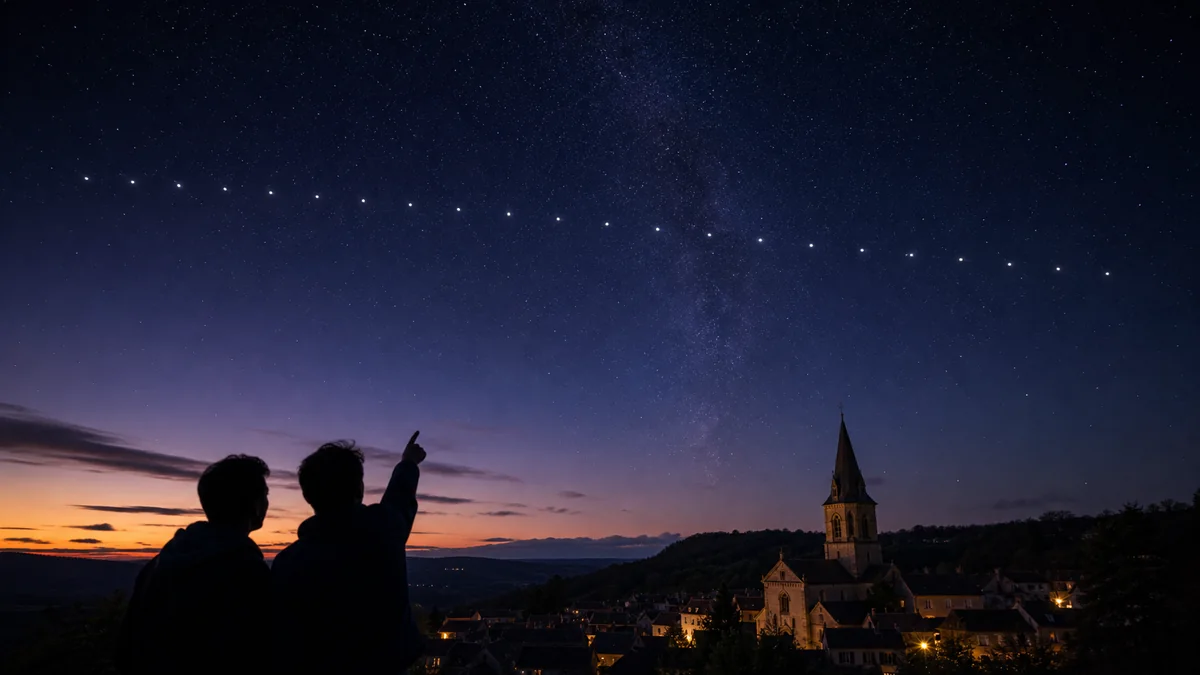
SpaceX satellite trains create lines of lights that intrigue observers worldwide.
How artificial intelligence and quantum computing will revolutionize our understanding of the cosmos, from dark matter to the origins of the Universe.
How, when and where to observe the Lyrids this year. Our tips + what AI detects in meteor trails.
From Venus's Ashen Light to Jupiter's flashes, every planet hides luminous phenomena that no one can explain.