The planets of the solar system
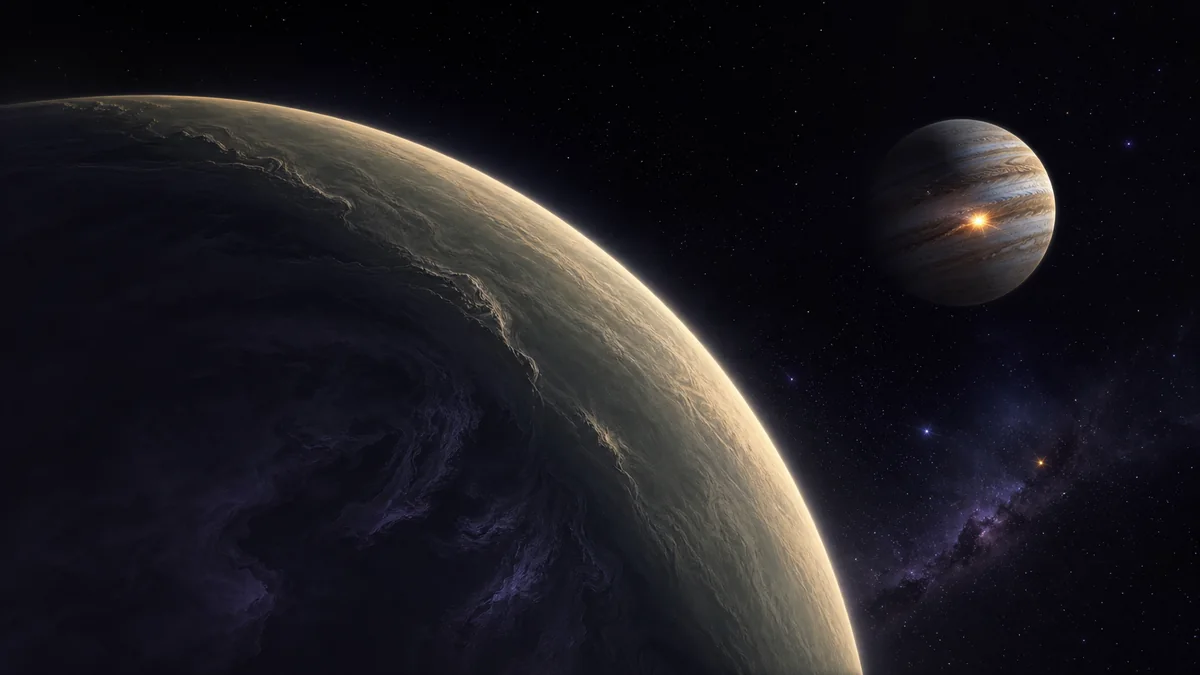
Eight worlds orbit the Sun, and no two are alike: a 465 °C furnace, a red desert, a striped ball bigger than 1,300 Earths, a planet lying on its side. Click on each one to discover it — size, distance, climate, and what it would be like to set foot there.
🪐 Explore the 8 planets
🌌 The planets in the real sky, right now
This is not a picture: it is the real sky computed right now. Swipe to explore, and tap a planet (☿ ♀ ♂ ♃ ♄) to find it in the explorer above. You can see exactly where they sit among the stars tonight.
Two families of planets
An invisible boundary, the "frost line", splits the solar system into two radically different worlds:
🪨 The terrestrials (rocky)
Mercury, Venus, Earth, Mars. Small, dense, with a solid surface you could walk on. Close to the Sun, they are hot and have few moons. Earth is the largest of the four.
🌀 The giants (gas & ice)
Jupiter, Saturn, Uranus, Neptune. Enormous, with no solid surface — mostly gas and ice around a small core. They rule the distant solar system, ringed and surrounded by dozens of moons.
If the Sun were a front door, Earth would be a pea 25 meters away, and Neptune a grape 800 meters away. The solar system is mostly made of empty space.
Where could we live?
Nowhere else, as things stand. Mars is the favorite for a future colony — solid ground, frozen water, a day of almost 24 h — but its air is 100 times too thin and it freezes at −60 °C on average. Venus is a hell at 465 °C under a pressure that would crush a submarine. Hopes of life turn instead toward icy moons: Europa (around Jupiter) and Enceladus (around Saturn) hide oceans of liquid water beneath their crust of ice — perhaps the best places to look for microbial life beyond Earth.
And Pluto?
Long the 9th planet, Pluto was reclassified as a dwarf planet in 2006. The reason: a planet must have "cleaned up" its orbit, yet Pluto shares its own with a host of other icy bodies in the Kuiper Belt. It has lost none of its interest — the New Horizons probe revealed it to us in 2015 with its famous heart of ice — but it joins Ceres, Eris and Makemake in the family of dwarf planets.
Observing the planets tonight
You don't need a telescope to start: Venus (the "evening star"), Jupiter and Mars are among the brightest points in the sky, and can be seen with the naked eye. With simple binoculars you can already make out Jupiter's four large moons; with a small telescope, Saturn's rings appear — a thrill every single time.
👉 Our 3D planetarium computes the real position of the planets right now: turn on the planets, and switch to "view from your location" to find out which ones are visible tonight above your horizon.
Frequently asked questions
How many planets are there?
Eight: Mercury, Venus, Earth, Mars (rocky), then Jupiter, Saturn, Uranus, Neptune (giants). Pluto has been a dwarf planet since 2006.
Which is the hottest planet?
Venus (≈ 465 °C), because of its extreme greenhouse effect — not Mercury, even though Mercury is closer to the Sun.
Why is Pluto no longer a planet?
It has not "cleared" its orbit: it shares its zone with other bodies in the Kuiper Belt. It is therefore a dwarf planet.
Could we live on another planet?
None is habitable as it is. Mars is the most considered; moons like Europa and Enceladus hide oceans favorable to microbial life.