What Is a UFO?
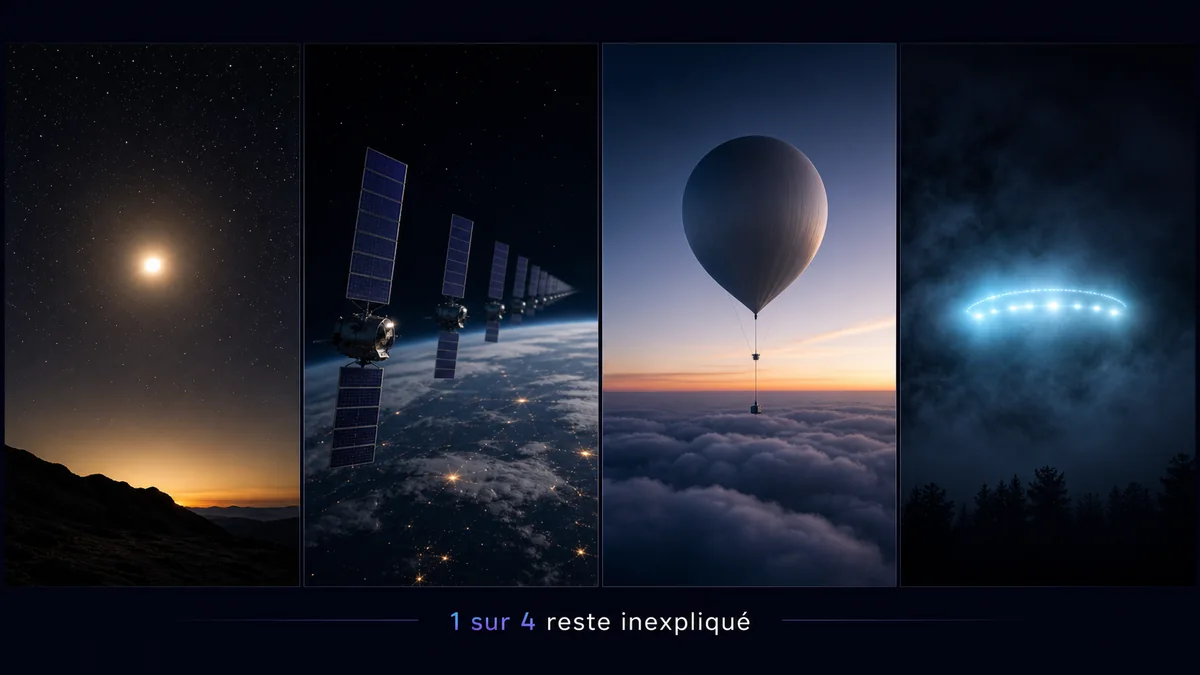
Complete definition of a UFO/UAP, the official terminology adopted by NASA and the Pentagon, global sighting statistics, the most frequently reported types, and a scientific status report for 2026.
A UFO (Unidentified Flying Object) is any aerial phenomenon that a witness cannot identify conventionally. The modern official term is UAP (Unidentified Anomalous Phenomena), adopted in 2022 by the Pentagon and NASA. About 95% of sightings are eventually explained by natural causes (aircraft, satellites, planets, meteors, balloons, drones, lanterns), while 5% remain unexplained after investigation.
What is the difference between a UFO and a UAP?
The term UFO (Unidentified Flying Object) was coined in 1953 by Captain Edward J. Ruppelt of the U.S. Air Force to replace the media expression "flying saucer," which had become too loaded. For nearly seventy years, UFO remained the standard term in the media, in popular culture, and even in most scientific publications.
In 2022, the Pentagon and NASA officially adopted the term UAP (Unidentified Anomalous Phenomena, formerly Unidentified Aerial Phenomena). This change is not cosmetic: it broadens the scope of study and neutralizes the extraterrestrial connotation that the word UFO had acquired.
- UFO
- The historical term, created in 1953. Strictly designates an object observed in the atmosphere that has not been identified. Often given an "extraterrestrial" connotation in popular culture.
- UAP (2020-2022)
- Initially "Unidentified Aerial Phenomena," adopted by the U.S. Navy in 2019 and the Pentagon in 2020.
- UAP (2022→)
- Renamed "Unidentified Anomalous Phenomena" by AARO in 2022 to include underwater objects (USOs), trans-medium objects (moving between air and water), and trans-atmospheric objects (between space and the atmosphere).
- PAN (France)
- The official French acronym used by GEIPAN/CNES: "Phénomène Aérospatial Non identifié" (Unidentified Aerospace Phenomenon). Four categories: PAN A (identified), PAN B (probable), PAN C (insufficient data), PAN D (totally unexplained).
What types of UFOs are reported most often?
Global databases (NUFORC in the United States, GEIPAN in France, MUFON, Hatch UDB) all converge on a remarkably stable typology since the 1950s. Shapes are far from evenly distributed: simple lights dominate by a wide margin.
- Point lights (about 40% of cases) — fixed or moving luminous points, often confused with planets, Starlink satellites or distant aircraft.
- Spheres and luminous balls (about 15%) — often orange, sometimes in formation. Chinese sky lanterns explain a significant share of cases since 2005.
- Triangles and boomerangs (about 10%) — popularized by the 1989-1990 Belgian wave and the Phoenix Lights sightings (1997).
- Discs and saucers (about 8%) — the historical shape (Kenneth Arnold, 1947), in relative decline since the 2000s.
- Cigars (about 5%) — elongated, slow-moving objects with no visible wings.
- Tic-Tacs (rapid growth since 2017) — white capsule-shaped objects with no wings or visible propulsion, popularized by the 2004 U.S. Navy videos (USS Nimitz).
- Cubes, crescents, amorphous shapes (about 2%) — rare but documented.
How many UFOs are reported per year worldwide?
Roughly 8,000 to 12,000 UFO sightings are reported worldwide each year to official organizations and citizen networks. The American NUFORC (National UFO Reporting Center) alone receives about 5,000 to 7,000 reports per year, the bulk of the global volume. MUFON (Mutual UFO Network) adds another 3,000 to 4,000 cases. In France, GEIPAN handles about 200 to 300 case files per year, a figure that has been rising since 2020.
For a deeper look at the numbers, reporting biases and geographic hot-spots, read our dedicated article: How many UFOs are reported per year worldwide?
What are the most common causes of sightings?
Statistical analysis of the GEIPAN, NUFORC and AARO databases shows that the vast majority of sightings can be identified after investigation. Here are the confirmed causes, in order of frequency:
- Aircraft and helicopters (about 25%) — navigation lights, landing lights, military helicopters at night.
- Starlink satellites, ISS, orbital debris (about 18%) — explosive growth since 2019 with the Starlink rollout (8,000+ satellites).
- Bright planets (about 12%) — Venus (the most reported), Jupiter, Mars at opposition.
- Balloons and lanterns (about 10%) — weather balloons, stratospheric balloons, Chinese sky lanterns.
- Meteors and fireballs (about 8%) — Perseid and Geminid showers, isolated bolides.
- Drones (about 8%) — civilian, military, lit up at night.
- Atmospheric phenomena (about 9%) — lenticular clouds, sun dogs, ball lightning, sprites.
- Hoaxes and optical illusions (about 5%) — window reflections, lens flares, edited footage.
- Unexplained (PAN D) (about 5%) — cases that remain open after thorough investigation.
How do the military (U.S. Navy, Pentagon) handle UAPs?
The major turning point came in July 2022, when the Department of Defense created AARO (All-domain Anomaly Resolution Office), initially led by astrophysicist Dr. Sean Kirkpatrick. AARO centralizes UAP reports from all U.S. military branches (Navy, Air Force, Army, Space Force) and coordinates interagency investigations.
In March 2024, AARO published its first historical report (Volume I), covering the 1945-1975 period. Its main conclusions: no evidence of an extraterrestrial origin, but official acknowledgment of a growing number of pilot reports (100-150 per year since 2021).
In April 2020, the U.S. Navy declassified three famous infrared videos:
- FLIR1 (a.k.a. Tic-Tac, 2004)
- Captured by Cmdr. David Fravor from the USS Nimitz off the coast of San Diego. A white capsule-shaped object performing maneuvers described as "out of bounds."
- GIMBAL (2015)
- Filmed from an F/A-18 Super Hornet aboard the USS Theodore Roosevelt. A rotating object over the Atlantic.
- GOFAST (2015)
- A spherical object moving rapidly above the ocean, partially reinterpreted by AARO in 2023 as an optical parallax effect.
What is NASA's position on UFOs?
In June 2022, NASA announced the formation of a UAP Independent Study Team, chaired by astrophysicist David Spergel (Simons Foundation, formerly Princeton). The final report, published on September 14, 2023, marked an institutional turning point: for the first time, the American civilian space agency formally recognized the scientific legitimacy of studying UAPs.
There is no conclusive evidence suggesting an extraterrestrial origin for UAPs. But we don't know what they are, and that is precisely why we have to study them. — David Spergel, Chair of NASA's UAP Independent Study Team, September 2023
A direct consequence of the report: NASA appointed a Director of UAP Research and launched several initiatives that mobilize satellites, artificial intelligence and machine learning to systematically analyze anomalous aerial phenomena using scientific data (rather than anecdotal testimony).
Is there evidence of an extraterrestrial origin?
No. As of 2026, no major scientific agency — NASA, ESA, CNES, the Royal Astronomical Society, the French Academy of Sciences — recognizes any confirmed evidence of an extraterrestrial origin for a UFO/UAP phenomenon. The most recent official reports (AARO Volume I 2024, NASA UAP Study 2023, GEIPAN 2024 review) all converge on this conclusion.
That does not mean the question is closed. Several important caveats:
- 2 to 5% of cases classified as PAN D (totally unexplained) resist any analysis, even with radar and multi-sensor data.
- The Drake equation and the Fermi paradox make the existence of extraterrestrial civilizations statistically plausible, but no radio detection has been confirmed to date (see our article on the 1977 Wow! Signal).
- The scientific debate remains open. Avi Loeb (Harvard, Galileo Project), Garry Nolan (Stanford) and several academic researchers are actively publishing on the topic.
What are the most famous cases in history?
- Kenneth Arnold (June 24, 1947, Mount Rainier, USA)
- A civilian pilot reported nine objects in formation moving "like saucers skipping across water." Origin of the expression "flying saucer."
- Roswell (July 1947, New Mexico)
- The crash of an object near Roswell, initially announced as a "captured flying disc" by the U.S. Air Force and later reclassified as a weather balloon from the secret Project Mogul.
- Trans-en-Provence (January 8, 1981, France)
- A case officially studied by GEPAN (the predecessor of GEIPAN), including chemical analyses of the surrounding vegetation. It remains classified as PAN D, unexplained.
- Rendlesham Forest (December 26-28, 1980, United Kingdom)
- Sighting by U.S. military personnel from the USAF Bentwaters base, often called "Britain's Roswell."
- Belgian Wave of triangles (November 29, 1989 – April 1990)
- More than 2,000 witnesses, including F-16 pilots. A silent triangular shape documented by the Belgian military.
- USS Nimitz Tic-Tac (November 14, 2004)
- Cmdr. David Fravor and Cmdr. Alex Dietrich observed a capsule-shaped object off the coast of San Diego. The FLIR1 video was declassified in 2020.
How do you report a UFO?
Several complementary channels are available:
- NUFORC (USA) — the National UFO Reporting Center. Online form at nuforc.org, the largest English-language database.
- MUFON (USA) — Mutual UFO Network, with field investigators. mufon.com.
- GEIPAN (France, CNES) — the official agency, online form at geipan.fr. Cases are archived, investigated and classified as PAN A/B/C/D.
- Vigi-Sky — citizen platform, open database, community validation, geolocation and multi-witness correlation. Submit a sighting.
For the complete guide (information to collect, P900 photos, EXIF, law enforcement, anonymity), read: How to report a UFO: 2026 guide.
Does the word "UFO" necessarily imply extraterrestrials?
No, absolutely not. The word UFO strictly means "Unidentified Flying Object": it describes a temporary state of ignorance on the observer's part, not an origin. A sighting remains a UFO only as long as it has not been identified. Once explained — for example, "Starlink satellite train" or "stratospheric balloon" — it technically ceases to be a UFO.
The semantic shift toward "extraterrestrial craft" is purely cultural, popularized by science fiction (Spielberg, X-Files, Roswell), sensationalist media and the sighting waves of the 1950s through the 1990s. It is precisely to neutralize this bias that NASA and the Pentagon adopted the term UAP in 2022.
UFO = a state of unknown to be explained, not a conclusion. The scientific approach is to investigate, not to presume.