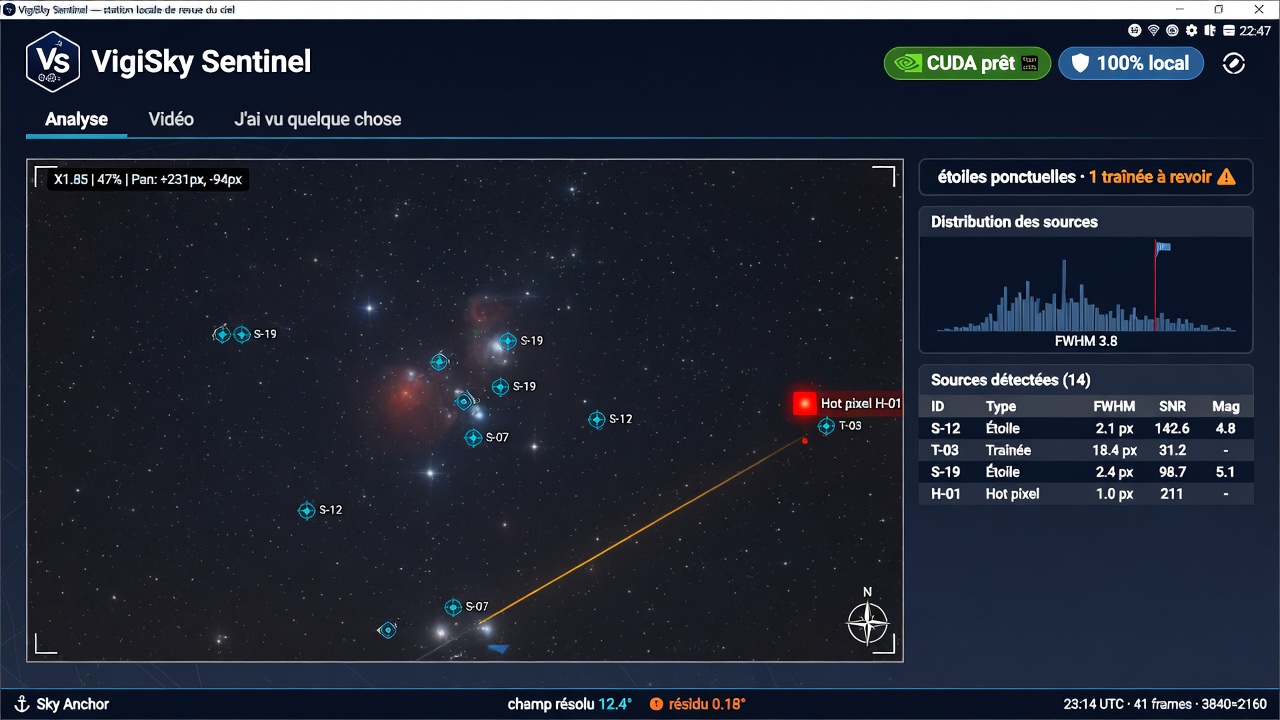
I have a photo
The engine extracts every source, classifies without crying UFO, and anchors the field to the stars.
A desktop app that applies a rigorous observation method: anchor the facts, verify the usual suspects, analyze the evidence, classify cautiously — and share only if you decide to.
Sentinel does not replace your judgment. It helps you not damage the data.
Download VigiSky Sentinel — free v0.45.0 · Windows 10/11 (64-bit) · 4.8 MB
The engine extracts every source, classifies without crying UFO, and anchors the field to the stars.
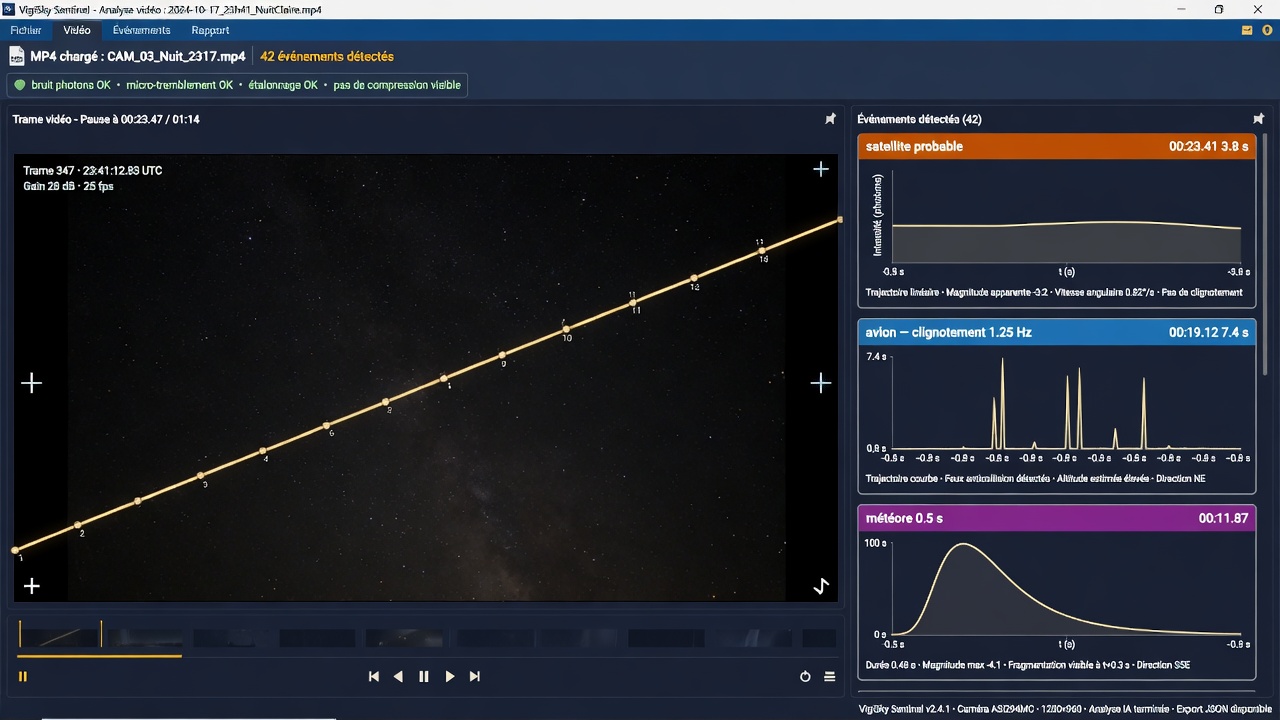
Trajectory, speed, blink period, authenticity clues. The file never leaves your PC.
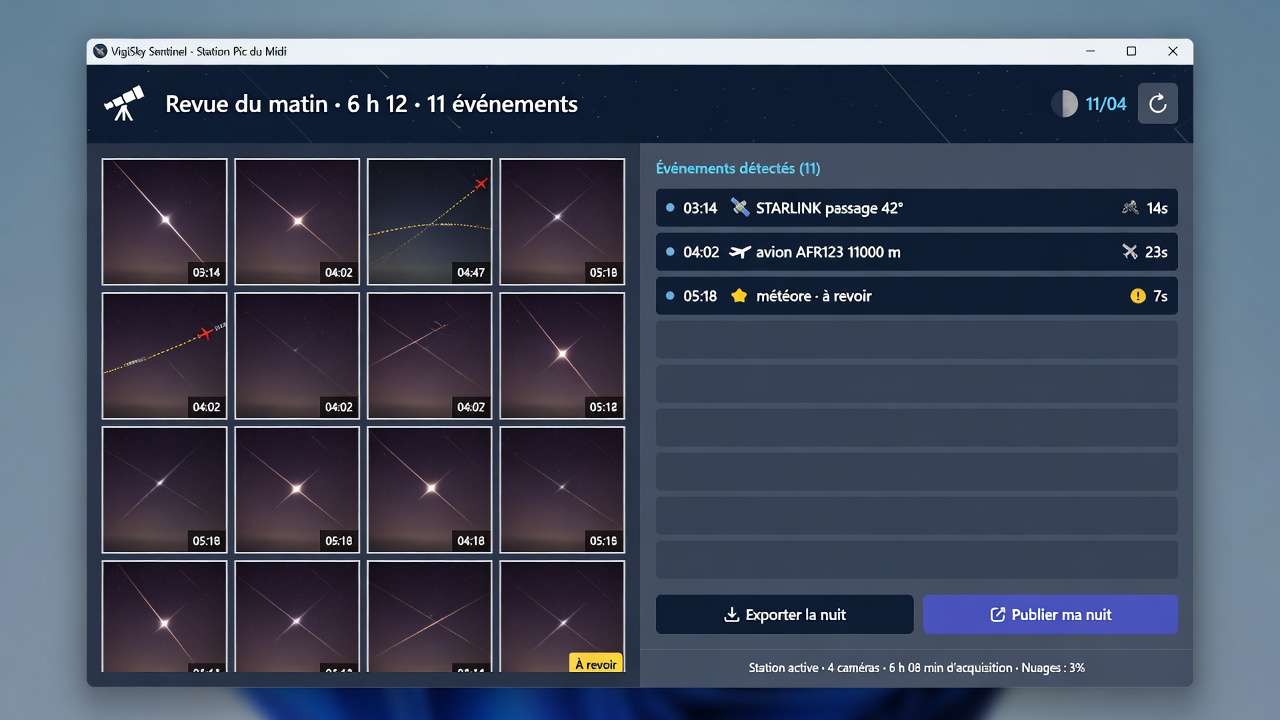
Webcam or fisheye: at dawn the review sorts satellites, aircraft and signals to revisit.
Sentinel downloads the Celestrak catalog (visual + stations), caches it, and computes passes with SGP4 on your PC. Morning review and the authenticity stamp work offline once a TLE set has been fetched. ↻ refreshes the catalog; you can also import a .tle file.
The old naive detector (threshold on the frame mean) is gone. Photos, demo skies, Cosmos hunt, camera watch and stacked video all go through the same astronomical pipeline: local background, matched filter, classified sources. One method, one verdict style.
CUDA stays the fast path on NVIDIA. Without a GPU, or compiled without the toolkit, Sentinel runs multi-thread on the CPU: same image analysis, same video tracking. The galactic Lab still needs the CUDA build.
Load your sighting video: every moving object becomes a dated event with its trajectory, angular speed and light curve. Aircraft strobe lights, satellite steadiness, meteor brevity — the engine recognizes them, and says so cautiously. It also measures authenticity clues (photon noise, micro-shake, frame cadence) to flag AI-generated or heavily processed videos — without ever crying fake. → The method explained
Sentinel recognizes the stars in your photo and derives exactly where the lens was pointing: field center to the arcminute, scale, rotation — computed locally, using the same mathematics as satellite star trackers (triangle matching). Stars get named on the image, a celestial grid overlays it, and any point in the photo receives measured coordinates. An unexplained light then has a position and angular size proven by the stars around it. The night watch anchors itself: the camera knows where it points, every event gets a real azimuth/elevation, and the satellite counter-check verifies the time and the direction. The measurement residual is always displayed — a weak solve says "uncertain", never the opposite.
One button in the header switches the whole application to English: interface, night watch, morning review, counter-checks. Your preference is remembered between launches. French remains the reference language — English is a display layer; case files and data are unchanged.
The star solver gains a rescue pass: when the standard sweep fails (badly wrong field hint, star-poor sky), it retries with extended bins then in depth — more stars, more triangles — within the same time budget. On the bench: 98% of fields solved "solid" under 30% impostors, 20% missing stars and 2 px of noise, zero false locks. Fields that already solved pay nothing.
Plug in an all-sky fisheye camera and the night watch solves the complete celestial dome: the solver automatically switches to the equidistant projection (r = f·θ), self-calibrates the focal length on the stars, and every event gets its measured azimuth/elevation — bench-validated to 0.18°. Combined with the marathon, that's a station watching the whole sky, every night, on its own.
Tick "Marathon" and leave for the weekend: at dawn, Sentinel closes the night and writes the morning review to disk; at dusk, the watch restarts by itself (local solar computation, validated to the degree). Power cut, camera cable unplugged? The station re-arms and resumes its night where it left off. A multi-night recap accumulates surveillance hours and recurrences — a true autonomous observation station.
Your stacked deep image now exports as 32-bit FITS, astronomy's scientific format — and when the field is star-anchored, the astrometric WCS is embedded in the header: the file opens already plate-solved in Siril, DS9 or PixInsight, every pixel knowing its celestial coordinates. Sentinel now speaks the language of observatories.
After a successful star anchoring, one click saves your lens's EXACT measured field as a named profile ("Garden dome", "S23 wide"…). From then on, everywhere — photo analysis, video, night watch — pick the profile instead of guessing: the solver starts from the true field, faster and safer. The foundation of multi-camera support.
Pick a folder: Sentinel analyzes every photo sequentially (up to 500), sorts the summary by interest — candidates first — and exports everything as CSV for your own tools. An observing station's routine, without touching each image.
One click on any tracked object and Sentinel generates a professional, print-to-PDF dossier: every measurement with its error margins (star-anchored rate, orbit test, light fingerprint, authenticity verdicts), the original file's SHA-256 fingerprint for evidence integrity, and a full methodology annex with the validation-bench results. The document you hand to an investigator, a journalist, a forum — generated locally, nothing leaves your PC.
The app's last honest refusal just fell: all-sky fisheye lenses (real watch-station hardware, 120-185° fields) are now star-solved — equidistant projection, focal length auto-calibrated to 0.2%, centers within arcminutes. And if your lens sits in the ambiguous zone (~100-140°), the app tries both models before giving up. A dome camera becomes a Sentinel station.
When two witnesses triangulate a fireball at the end of its luminous flight, Sentinel integrates the dark flight: gravity, atmospheric drag and winds, fragment by fragment. The 10-gram pieces drift with the wind, the 10-kilo ones carry far: the fall zone takes shape, mass by mass, with coordinates. The day a fireball crosses the sky, the network's videos will be able to say where to look for the stone.
Sentinel now archives your watches and cross-references the nights. An object seen several nights in the same region of the sky, with a steady time shift (−4 min/day…): that is the orbital signature — a satellite, even an uncataloged one, is far more likely than a one-off phenomenon. Exactly fixed schedule? Probably a scheduled flight. The morning review tells you on its own: "seen 5 nights around 23:40, shifting −3.9 min/day, predictable to ±1 min".
When you wake up, one button in the morning review: "Publish my night". Your watch joins the network's public page: satellites, aircraft, meteors and signals to re-examine, counted and cross-checked, station by station. Voluntary and anonymous: position rounded to ~11 km, never an address, no images. The sky, watched every night, told every morning.
Every moving object now gets its fingerprint: the autocorrelation of its light curve extracts the blinking period. A tumbling rocket body beats at a steady 3 seconds, aircraft strobes at 1 Hz, a cruising Starlink is flat, a lantern flickers with no rhythm. "Periodic blinking: 3.00 s (12 periods seen)" — one more physical clue in the case file, never a magic identification.
"What if the object emitted no light at all?" Here is the answer. During every video analysis, Sentinel monitors the flux of the field's fixed stars: a dark object crossing extinguishes them one by one — a sequence of extinctions aligned along a constant-velocity front. A cloud also blots out stars, but wide, diffuse and disorderly: it is recognized and rejected, as is scintillation. Even a black object leaves a trace — the stars it hides.
A lone witness cannot know the distance of a light in the sky. Two witnesses aiming at it at the same moment can: their sightlines cross in space. Sentinel now triangulates the network's full trajectories: real altitude with error bounds, speed in km/h, and the parallax verdict — "object too distant for this baseline, spread the stations out" when the geometry cannot conclude. Witness positions never leave the server: the geometry travels in a relative frame.
A star-anchored video trajectory gives no distance… unless the object follows an orbit. Sentinel rebuilds the 3D track for every possible altitude: at the right one — and only there — the measured angular rate matches the Keplerian rate and the motion is planar and uniform. Result: "compatible circular orbit: ~420 km, period 92.8 min". An aircraft, too irregular, fits no altitude — and the app says so. Textbook celestial mechanics, on a phone and a PC.
A starry-sky video claims it was filmed somewhere, at some time? Sentinel recomputes the sky of that very moment and confronts it: was the identified star field above the horizon? Is the sky's rotation (0.25°/minute) measurable in the video — composites never have it? Was it daylight? Should Jupiter or the Moon have been in frame? Each test returns its own verdict — compatible, contradicted, or untestable — never a magic "real/fake". The method explained: proof by the stars. v2: expected bodies are now verified in the frame (is a bright source measured at the predicted pixel? Jupiter missing = contradiction), and the video's moving object is cross-checked against cataloged satellites at the claimed time — per-test verdicts, as always.
Real lenses bend the sky: barrel or pincushion distortion, 1–4 % at the edge of a phone's field. While anchoring to the stars, Sentinel now measures that distortion on your own photo — and corrects it. The panel says it plainly: "barrel distortion 2.1% at the corner — measured and corrected". On a clean lens nothing changes: the correction only engages when it clearly improves the residual; otherwise the app tells you "no significant lens distortion detected". v2.1: edge-of-field stars pushed away by distortion are re-captured once the model is measured — more matched stars, better accuracy exactly where the lens bends most.
The morning review already cross-checked every event against satellites — it now also checks real air traffic (sampled during the night via OpenSky Network): "✈️ AFR123 was in that direction, altitude 11,000 m". And for brief streaks, the active meteor showers: "☄️ consistent with the Perseids — radiant 40° up, near peak". Satellites, aircraft, meteors: the three usual suspects, checked automatically every night against real data.
Film the sky for 20 seconds: Sentinel aligns every frame on the stars (to a tenth of a pixel) and stacks them. Noise collapses with the square root of the frame count — stars invisible in one frame appear across three hundred. Two outputs: the deep image (aligned mean, analyzable in the studio and star-anchorable) and the trails (per-pixel maximum — moving objects draw their full path). The astronomers' "lucky imaging" technique, in one click.
Analyze a video then anchor it to the stars: every moving object gets a trajectory in true celestial coordinates and its measured angular velocity (no more assumed-field estimates). One click exports the trajectory to the VigiNet network in the witness-sighting format: it becomes identifiable and triangulatable as if a witness had tracked it by phone — at instrument grade. Tested on a real ISS pass geometry: direct match at 0.4°.
Like sailors with a sextant, but automatic: lay the phone flat facing the sky, take 2–5 photos, and Sentinel recognizes the stars at your zenith to derive your latitude and longitude — no GPS, no network. The point of sky directly above you has a declination equal to your latitude and a right ascension equal to your local sidereal time: a three-century-old formula, solved by the stars. Honest accuracy shown (it depends mostly on how level the device is): an educational sextant and an offline fallback.
Plug in a camera — a webcam or an all-sky fisheye up to 185° — and Sentinel watches the sky all night. In the morning: the morning review — everything that moved, classified, with snapshots. Give the station's position and every event is automatically cross-checked against the night's bright satellite passes (Celestrak data): "STARLINK was passing at that time, culminating at 45°" — the book's chapter 7 counter-investigation, automated. A time match is a clue, never a confirmation.
The Deep Sky Engine analyzes your photo like an observatory: local sky background, extraction of every light source (sub-pixel centroid, FWHM, elongation), cautious classification — star, satellite trail, hot pixel, or signal worth a second look. A 24 Mpx photo takes ~0.2 s on an NVIDIA GPU; without one, the CPU takes over.
Each observation becomes a numbered, exportable investigation sheet: witness data, checks performed, analysis, verdict — and its limits, stated in plain words. Never "UFO detected".
A CUDA galaxy simulator — one million stars, dark matter, the Milky Way-Andromeda collision, ring galaxies, live supernovae — to understand what "astronomical unknown" really means.
| System | Windows 10 or 11, 64-bit |
| Graphics card | NVIDIA (CUDA) recommended for speed — optional, everything also runs on CPU |
| Internet connection | Not required (only for voluntary VigiNet sharing) |
| Price | Free |
Sentinel is the companion of « J'ai vu quelque chose dans le ciel — le guide du témoin » (Vigi-Sky) — the witness-method handbook behind this ecosystem, currently in French: 181 pages, 33 visuals, real GEIPAN case files from Aveyron. The book stands alone; so does the app. Together they make your case file worth something.
📖 Paperback is out — the book (French) →
How can I analyze a sky video without uploading it to a server?
VigiSky Sentinel analyzes the video entirely on your computer: each moving object becomes a dated event with its trajectory, angular velocity and light curve. Nothing is uploaded — the file stays with you.
How can I tell if a UFO video is AI-generated?
Sentinel measures three physical clues that a real camera leaves and a generator imitates poorly: sensor photon noise, hand-held micro-tremor and frame cadence. It reports clues, never proof.
Is the app really free?
Yes: free, no account, no ads and no subscription. It runs offline, and nothing leaves your computer unless you explicitly choose to share a case file.
Do I need an NVIDIA graphics card?
No, it is optional. An NVIDIA (CUDA) GPU speeds up analysis — a 24 Mpx photo in about 0.2 seconds — but everything also runs on the CPU, just a bit slower.