The Sun, our star
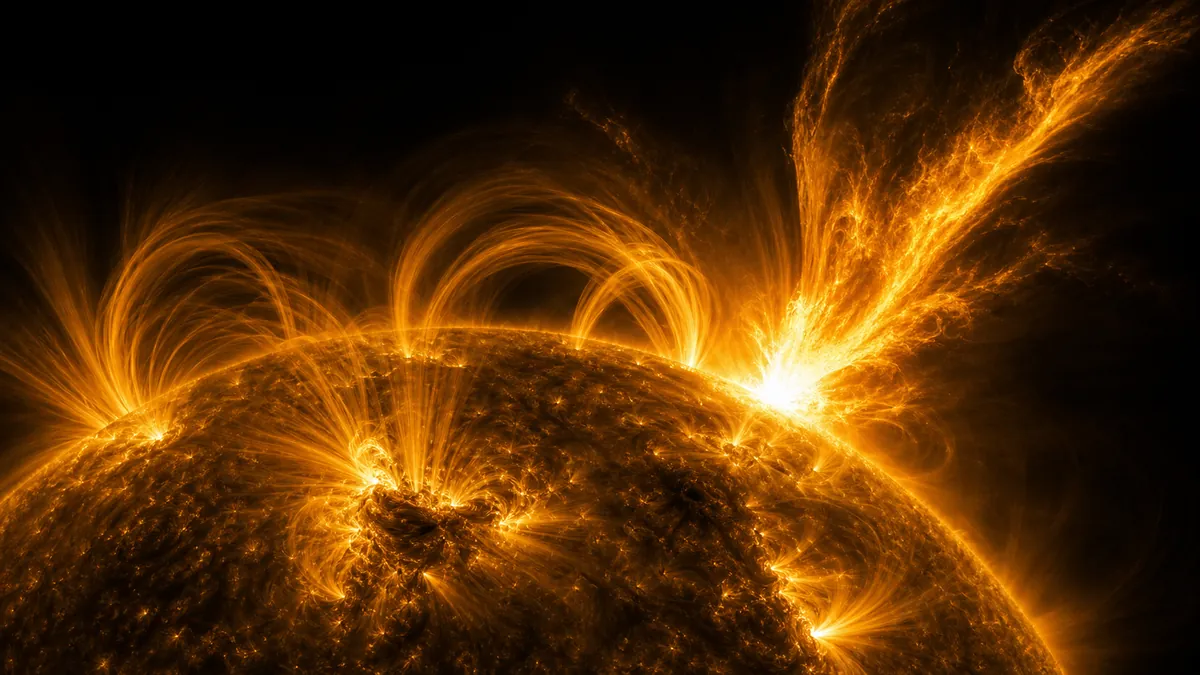
A ball of plasma 1.4 million kilometres across, a core at 15 million degrees, and light that took a million years to climb out before reaching you in 8 minutes. Here is everything you need to understand about the star that drives the solar system — from the core to the corona.
What the Sun really is (it's not fire)
People often say the Sun "burns", but that's wrong. Fire is a chemical reaction with oxygen — and there's none of that in space. The Sun is a ball of plasma: a gas so hot that its atoms have lost their electrons. Made of roughly 73% hydrogen and 25% helium (by mass), it isn't held together by any shell: it's its own colossal gravity that squeezes it, and that compression ignites a nuclear fusion at its centre. The Sun is a perfectly ordinary star — a G-type yellow dwarf — and there are hundreds of billions of them in our galaxy alone. But this one is ours.
Journey to the centre of the Sun: the 6 layers
Click on each layer of the cutaway to explore it — from the central furnace to the ghostly corona, hotter than the surface it surrounds.
☀️ The Sun travels among the stars
Seen from Earth, the Sun drifts slowly in front of the zodiac constellations, one per month. Here is its real position today on the celestial sphere (the golden marker) — the constellation it sits in is the one you CANNOT see at night right now, hidden by its glare.
Fusion: how a star makes light
At the core, four hydrogen nuclei transform, in several steps, into a single helium nucleus. The magic trick: the helium produced weighs 0.7% less than the four starting hydrogens. That missing mass hasn't vanished — it has become energy, according to the most famous formula in physics.
E = mc² — the lost mass (Δm) becomes light. Multiplied by 600 million tonnes per second.
This energy is born as ultra-powerful gamma photons. But they don't travel in a straight line: they are absorbed and re-emitted billions of times in the radiative zone, bouncing in every direction. The astonishing result: the light leaving the Sun today took between 100,000 and a million years to climb from the core to the surface. Then only 8 minutes and 20 seconds to cross the 150 million kilometres to your eyes. This morning's sunlight is older than the human species.
Every second, the Sun releases more energy than humanity has consumed in its entire history — and it has been doing so for 4.6 billion years.
Sunspots and the 11-year cycle
The Sun's surface isn't smooth: it boils in granules the size of a country, and is sometimes dotted with sunspots — "cool" zones (still 4,000 °C!) where intense magnetic fields slow the heat rising from below. Their number follows a cycle of about 11 years: the Sun swings from a nearly spotless minimum to a maximum riddled with spots, where flares and storms multiply. We happen to be near the maximum of Cycle 25 — which is why the auroras of 2024-2025 were so spectacular.
👉 To follow activity live (flares, storms, the Kp index), it's all on our Solar activity & geomagnetic storms page, and to find out whether an aurora is possible where you are, try the aurora forecaster.
The life of a star: where does the Sun come from, where is it going?
The Sun hasn't always existed and won't shine forever. Here is its biography, past and future:
The Sun isn't massive enough to explode as a supernova. It will end gently, as a white dwarf. And the atoms that make up your body — carbon, oxygen, iron — come from larger stars that died before the Sun was born. You are, literally, stardust.
Without the Sun, nothing
The Sun doesn't just light up the day. Its gravity holds the entire solar system in orbit. Its light feeds plants (photosynthesis), and therefore the whole food chain. Its energy creates the winds, the ocean currents, the water cycle, the climate. Its magnetic field blows a protective bubble, the heliosphere, that shields us from cosmic rays. The oil and coal we burn are solar energy stored away millions of years ago. Almost all of Earth's energy is solar energy — direct or canned.
Observing the Sun without burning your eyes
Never look at the Sun directly with the naked eye, and even less through unfiltered binoculars or a telescope: the concentrated light burns the retina within seconds, painlessly (the retina has no pain receptors) and with no possible recovery. Sunglasses, X-ray films, CDs and smoked glass do not protect you.
The good news: properly equipped, the Sun is the most accessible object in the sky — visible in broad daylight, rich in detail. Three safe ways to admire it:
- ISO 12312-2 certified eclipse glasses — to look with the naked eye (spots, partial eclipses). A few euros, indispensable.
- A full-aperture solar filter on binoculars or a telescope — placed in front of the objective, never behind the eyepiece.
- Projection — projecting the Sun's image onto white card, without ever looking through the instrument. Ideal for a group.
With a telescope fitted with a suitable filter, you'll watch sunspots evolve from day to day, and even — with a special H-alpha filter — the prominences: those arches of glowing plasma that leap off the edge of the disc, as large as ten Earths.
Frequently asked questions about the Sun
What is the Sun made of?
A ball of plasma: ≈ 73% hydrogen, 25% helium, the rest in heavier elements (oxygen, carbon, iron…). Neither fire nor solid — an ionised gas held together by its gravity.
What is the temperature of the Sun?
≈ 15 million °C at the core, ≈ 5,500 °C at the visible surface. Strangely, the corona exceeds a million degrees — a mystery still debated by physicists.
How long does light take to reach us?
8 min 20 s from the surface. But the energy first took 100,000 to 1 million years to climb from the core. This morning's light is older than humanity.
Will the Sun burn out?
Yes, in ~5 billion years: it will swell into a red giant, then end as a white dwarf. No supernova — it's too light for that.
Can you look at the Sun directly?
Never without an ISO 12312-2 certified filter. Retinal damage is painless and irreversible. Sunglasses are not enough.